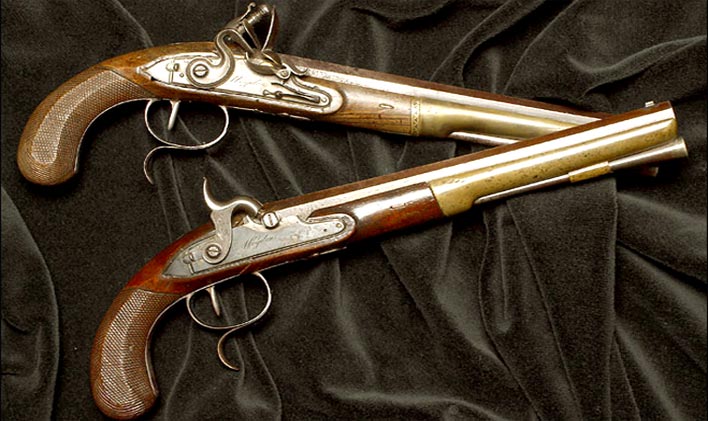
Introduction: The Duel -- Hamilton and Burr, 1804

From the American Experience

On July 11, 1804, two of the most famous men in America stood in a clearing at Weehawken, New Jersey, facing each other with loaded dueling pistols.

It's a little hard for us to imagine -- the stilted, deadly ritual of the scene, the highly mannered decorum of the two protagonists, like theater, not reality. But very real it was.

Alexander Hamilton and Aaron Burr were in the prime of life, both men of exceptional ability and blazing ambition. Both had served bravely in the Revolutionary War. Both were New Yorkers, sophisticated, accustomed to lavish living, distinguished in the law and in politics; just as both were accomplished intriguers, devoted fathers, notorious philanders, and not incapable of doing in a political opponent, if they thought that necessary.

But where Aaron Burr was highly intelligent, Alexander Hamilton was brilliant. Indeed the imprint of Hamilton's genius on the emerging nation can hardly be overstated. George Washington had considered him the outstanding member of his cabinet, more brilliant even than Jefferson. Burr was the more gifted charmer of the two, and Burr's distinguished lineage stood in marked contrast to Hamilton's illegitimate birth. Burr was also the better politician, who, had it not been for Hamilton, could well have been president, instead of Jefferson. But then that's part of the story that brought them to Weehawken that fateful morning . . . .

back to top


Question: The Duel -- Hamilton and Burr, 1804

The facts surrounding the duel are fairly well established. A narrative of the day's events can be found at the American Experience website.

However, historians still disagree about a crucial question:

Did Alexander Hamilton try to kill Aaron Burr on the the Plains of Weehawken, or did he purposefully throw away his shot, firing into the air, leaving his fate in Burr's hands?

Your task is to read the documents provided as part of this exercise and come to class with an answer to the question. Did Hamilton try to kill Aaron Burr?


back to top


Alexander Hamilton: The Duel -- Hamilton and Burr, 1804

From the American Experience

This Founding Father came to America alone at age 15. He fought at Washington's side in the Revolution, helped ensure the ratification of the Constitution, and saved the fledgling United States from financial ruin. He died in a tragic duel with his political rival, Aaron Burr.

Alexander Hamilton was born on January 11, 1757, in Nevis, British West Indies. His father, James Hamilton, was a Scottish trader. His mother, a French woman named Rachel Fawcett Lavine, was married to another man, John Michael Lavine, at the time of Alexander's birth. She had been cast out of Mr. Lavine's home for adultery. When Alexander was still an infant, James Hamilton abandoned his family. They struggled to survive.

Owing to his intelligence and willingness to work, Alexander Hamilton quickly rose above his station. At age 11, he went to work as a clerk in a countinghouse owned by a St. Croix businessman, Nicholas Cruger. Impressed with the boy, Cruger joined with a minister, the Reverend Hugh Knox, to send young Hamilton to study in America.

In the fall of 1773, at age 16, Hamilton entered King's College, which would later be renamed Columbia. In 1774, as the Colonies swept toward revolution, he left school to begin a career in politics. That year he wrote "A Full Vindication of the Measures of Congress," which defended the First Continental Congress' proposal to embargo trade with Great Britain.

In 1776, after the Revolutionary War began, Hamilton received a captain's commission in the Continental Army. He raised an artillery company of his own and proved his bravery at the Battles of Long Island, White Plains, and Trenton.

George Washington was among those who recognized Hamilton's leadership capabilities. In 1777 Hamilton accepted a position on Washington's staff. At the time of Hamilton's appointment, the Army was plagued by poor organization and a lack of financing. The prescient Hamilton, realizing that these problems would also plague the liberated colonies unless they were solved, began to search for solutions.

Alexander Hamilton served admirably throughout the war. During this time he found love in the person of Elizabeth Schuyler, daughter of a powerful New York landholder and military officer, Philip Schuyler. Alexander and Elizabeth married in 1780. For the most part, their marriage was a happy one, but later it would suffer from Hamilton's infidelity.

Following the war, Hamilton passed the New York bar and set up practice in New York City. Among his first clients were Loyalists, people who kept their allegiance to the King of England during the war. At the war's end, many New York rebels returned to find their homes and businesses occupied by Loyalists. Under the Trespass Act, these people could sue Loyalists for compensation for the use of and damage to their property. Hamilton's powerful defense of Loyalists helped establish principles of due process and ensure the Trespass Act's repeal.

In 1787 delegates met in Philadelphia to repair the weak Articles of Confederation, which were failing to hold the union together. Hamilton, a New York delegate, believed that the solution to the problem involved creating a stronger central government and providing a steady revenue stream for this government.

Although Hamilton had little influence on the writing of the Constitution, he was a driving force for its ratification. Along with John Jay and James Madison, Hamilton wrote "The Federalist," a series of essays that defended the yet-to-be-approved Constitution. Hamilton composed more than two-thirds of the 85 essays, which were published in New York newspapers in 1787-88. Later in 1788, Hamilton attended the New York ratification convention. Using his considerable skill as an orator, he turned back an overwhelming Anti-Federalist tide to win ratification.

Upon his election in 1789, George Washington chose Alexander Hamilton as the nation's first Treasury secretary. Hamilton crafted a monetary policy that undoubtedly saved the nation from ruin. Among the features of the Hamilton plan were the payment of federal war bonds, the assumption of state debts by the federal government, and the creation of a mechanism for collecting taxes.

During his tenure as Treasury secretary, Hamilton clashed repeatedly with another cabinet member, Thomas Jefferson. Hamilton favored a powerful central government while Jefferson feared it; Hamilton favored closer relations with Britain, and Jefferson, with France. The men would both resign their Cabinet posts before the end of Washington's first term. They would remain lifelong political enemies.

Hamilton might have risen to the presidency if not for a scandal in 1797. A pamphlet published that year revealed Hamilton's affair with a woman named Maria Reynolds and linked him to a scheme by Reynolds' husband to illegally manipulate federal securities. To prove his innocence, Hamilton resorted to publishing love letters he had written to Maria Reynolds. This cleared Hamilton of financial impropriety, but badly damaged his reputation. The scandal did not stop George Washington from appointing Hamilton acting commander of the U.S. Army in 1798 when the country was on the brink of war with France.

In 1800 Hamilton's old enemy, Aaron Burr, obtained and published a confidential document Hamilton had written that was highly critical of Federalist John Adams, then president. Publication of the article created a rift in the Federalist party, helping Republicans Thomas Jefferson and Aaron Burr to win the race for presidency. But since the two men tied in electoral votes, it was up to Congress to decide the outcome. Hamilton lobbied Congressional federalists to vote for Jefferson, to little effect. Still, Congress chose Jefferson as president. Burr assumed the vice presidency.

In the New York gubernatorial race of 1804, Hamilton again clashed with Aaron Burr. Burr ran as an independent. Hamilton feared that Burr would eclipse him in the Federalist leadership. He spoke out against the vice president, and New York Republicans George and DeWitt Clinton led a brutal media campaign against Burr. The Clintons, not Hamilton, were responsible for Burr's defeat.

Still, after reading in a newspaper that Hamilton had expressed a "despicable opinion" about him during the campaign, Burr challenged Hamilton to a duel. They met on the dueling grounds at Weehawken, New Jersey on July 11, 1804. Both men fired their pistols; only Hamilton was hit. He died of his wounds the next day.


back to top


Aaron Burr: The Duel -- Hamilton and Burr, 1804

From the American Experience

If he had been able to keep his ambition in check, Aaron Burr might have become president. Instead, he became known as the man who killed Alexander Hamilton and as one of the most notorious traitors in history.

Aaron Burr was born in Newark, New Jersey, on February 6, 1756. His father, Reverend Aaron Burr, was president of the College of New Jersey, which would later be renamed Princeton. His mother, Esther Edwards Burr, was the daughter of theologian Jonathan Edwards, whose preaching helped precipitate the religious movement known as the Great Awakening. Aaron Burr was orphaned at 2. He was raised by his uncle, Timothy Edwards.

From an early age, Aaron showed signs of brilliance. He applied for admission to the College of New Jersey (later Princeton) at age 11, but was turned down. At age 13, he reapplied and was granted admission as a sophomore; he graduated at age 17.

When the Revolution began, Burr, then 19, unsuccessfully sought a commission from George Washington, Commander-in-Chief of the Continental Army. A disappointed Burr joined Benedict Arnold's march against British strongholds in Canada. Later, he transferred to another force in Canada which was led by General Richard Montgomery.

When Montgomery attacked Quebec, on December 31, 1775, the Continental force was badly defeated, but Burr distinguished himself on the field. In 1776 he served briefly on Washington's staff. The next year, as a lieutenant colonel, he took command of a regiment, which would later distinguish itself at the battle of Monmouth. Later he was placed in command of the "neutral ground" north of New York City, where he guarded against British guerilla raids and cavalry forays. The job proved extremely difficult, and Burr persevered as long as he could. Exhausted and ill, he retired from the military in 1779.

That same year, Burr met Theodosia Prevost, the widow of a British officer. She was ten years his senior, but Burr found her intellect irresistible. They married in 1782, just after Burr passed the New York bar. As an attorney in New York, Burr had few equals. He commanded large fees, with which he furnished splendid homes, clothed himself and his wife in the most elegant fashion, and entertained lavishly. Soon, he began his rise in the political field.

A master of politics, Burr specialized in self-interest. In 1783 he was elected to the New York Assembly. In 1789 he was appointed the state's attorney general. Two years later, Burr made the jump to national politics, taking a United States Senate seat from Philip Schuyler, a powerful New York landowner and Alexander Hamilton's father-in-law. Burr held the seat for just one term.

His wife Theodosia gave birth to four children; -- only one survived. Named after her mother, she was Aaron Burr's pride and joy. When Burr's wife died in 1794, young Theodosia became the most important woman in his life.

In 1800 Republican Thomas Jefferson chose Aaron Burr as his presidential running mate. When the election results were tallied, Burr and Jefferson tied in total electoral votes. Congress would vote to decide the winner. Wary of appearing underhanded, Burr refused to lobby Congress for votes. Alexander Hamilton, who despised Jefferson but hated Burr even more, lobbied for Jefferson, to little effect. But Jefferson won the election, and Burr became his vice president.

Jefferson gave his vice president little power in the administration and even barred Burr's nomination for a second term as vice president. Ever practical and determined to rise, Burr began a flirtation with the Federalist Party. In 1804, with covert Federalist backing, Burr ran as an independent candidate for governor in New York. With the secret support of Jefferson, George and DeWitt unleashed slanderous attacks on Burr in the press. Burr was beaten soundly in the general election.

Alexander Hamilton, who feared that Burr would take away the power he held in the Federalist Party, had also spoken out against Burr. Although Hamilton's efforts had little effect on the election, Burr later read in a newspaper article that Hamilton had expressed a "despicable opinion" of him.

Angry and depressed over his defeat, Burr decided to try and restore his reputation by challenging Hamilton to a duel. Burr may have hoped that Hamilton would apologize, but the communication between the men escalated until a duel was unavoidable. On July 11, 1804, on the dueling grounds at Weehawken, New Jersey, Burr shot Hamilton dead. In New York and New Jersey, Burr was charged with murder. And in much of the Northeast, Hamilton was mourned as a fallen hero. But to many Americans, particularly in the South, Burr was viewed as a man who had rightfully defended his honor.

Although he was a wanted man, Burr nonetheless enjoyed immunity from prosecution in Washington, D.C. There, he presided over the impeachment trial of Samuel Chase, an associate justice of the U.S. Supreme Court. Burr set a remarkable standard for decorum and fairness during the trial, in which Chase was acquitted. This would not be the last time Burr appeared in a highly publicized federal trial. The next time he would be the defendant in a trial for treason.

The United States purchased the Louisiana Territory from France in 1803. Aaron Burr saw the territory as a place where his political hopes could be revived. Conspiring with James Wilkinson, Commander-in-Chief of the U.S. Army and Governor of Northern Louisiana Territory, Burr hatched a plot to conquer some of Louisiana and maybe even Mexico and crown himself emperor.

Burr sought help from both Britain, who considered his proposals but turned him down. With private backing, Burr trained and outfitted a small invasion force. But Wilkinson betrayed him, and Burr was captured in Louisiana in the spring of 1807 and taken to Richmond, Virginia, to stand trial for treason. Acquitted on a technicality, he faced resounding public condemnation and fled to Europe.

Burr's European adventures proved less than rewarding. Again, plotted to take territory in North America, but failed to gain support from European powers. He returned to the United States, a fugitive from debtors' prison.

When Burr arrived in New York, the US was on the brink of war with Britain. His treason plot and the killing of Hamilton largely forgotten. Burr was able to get the murder charges against him dropped, and he once again began to practice law. The death of his daughter Theodosia, whose ship was lost at sea in 1813, devastated Burr, who said he felt "severed from the human race."

In 1833, Burr married again, this time to Eliza Jumel, a wealthy widow; the marriage soon ended in divorce. He died three years later, at the age of 80, a nearly forgotten man.


back to top


Documents: The Duel -- Hamilton and Burr, 1804

BEFORE THE DUEL

The final, fateful disagreement between Alexander Hamilton and Aaron Burr began in June 1804, when Burr was informed that Hamilton had made some disparaging remarks about him. The remarks were referenced in a letter published by Dr. Charles Cooper, who had overheard Hamilton's statements at a dinner party in Albany, New York.

When Burr read Cooper's account of Hamilton's statements, Burr sent a letter to Hamilton demanding an explanation. . . .

FOR ALL PRIMARY DOCUMENTS IN ONE PDF FILE CLICK HERE

Aaron Burr to Alexander Hamilton -- 18 June 1804 | link

Alexander Hamilton to Aaron Burr -- 20 June 1804 | link

Aaron Burr to Alexander Hamilton -- 21 June 1804 | link

Aaron Burr to Alexander Hamilton -- 22 June 1804 | link

Alexander Hamilton to Aaron Burr -- 22 June 1804 | link

Alexander Hamilton to Nathaniel Pendleton (friend and second) -- 27 June - 4 July 1804 | link

Alexander Hamilton to Elizabeth Hamilton (wife) -- 4 July 1804 | link

Nathaniel Pendleton's rules for the duel | link


ACCOUNTS OF THE DUEL
Duels were private affairs between gentlemen. They were technically illegal and thus occurred under the cloak of secrecy. Three witnesses provided testimony about the events on July 11, 1804.

1) Nathaniel Pendleton (Hamilton's friend and second) and William Van Ness (Burr's friend and second) wrote a joint statement a few hours after the duel -- 11 July 1804 | link

2) A week later, Nathaniel Pendleton elaborated on his account to demonstrate that Alexander Hamilton had not fired at Aaron Burr -- 19 July 1804 | link

3) William Vann Ness responded to Nathaniel Pendleton's revised account -- link

4) Five weeks after the duel, Dr. David Hosack -- a physician who cared for Hamilton (but did not see the duel itself) -- wrote to a friend confirming the statements of Pendleton -- 17 August 1804 | link

back to top


Code Duello: The Duel -- Hamilton and Burr, 1804

From the American Experience

Code Duello: The Rules of Dueling
Reprinted from "American Duels and Hostile Encounters," Chilton Books, 1963.
--------------------
The Code Duello, covering the practice of dueling and points of honor, was drawn up and settled at Clonmel Summer Assizes, 1777, by gentlemen-delegates of Tipperary, Galway, Sligo, Mayo and Roscommon, and prescribed for general adoption throughout Ireland. The Code was generally also followed in England and on the Continent with some slight variations. In America, the principal rules were followed, although occasionally there were some glaring deviations.
--------------------

Rule 1. The first offense requires the first apology, though the retort may have been more offensive than the insult. Example: A tells B he is impertinent, etc. B retorts that he lies; yet A must make the first apology because he gave the first offense, and then (after one fire) B may explain away the retort by a subsequent apology.

Rule 2. But if the parties would rather fight on, then after two shots each (but in no case before), B may explain first, and A apologize afterward.

N.B. The above rules apply to all cases of offenses in retort not of stronger class than the example.

Rule 3. If a doubt exist who gave the first offense, the decision rests with the seconds; if they won't decide, or can't agree, the matter must proceed to two shots, or to a hit, if the challenger require it.

Rule 4. When the lie direct is the first offense, the aggressor must either beg pardon in express terms; exchange two shots previous to apology; or three shots followed up by explanation; or fire on till a severe hit be received by one party or the other.

Rule 5. As a blow is strictly prohibited under any circumstances among gentlemen, no verbal apology can be received for such an insult. The alternatives, therefore -- the offender handing a cane to the injured party, to be used on his own back, at the same time begging pardon; firing on until one or both are disabled; or exchanging three shots, and then asking pardon without proffer of the cane.

If swords are used, the parties engage until one is well blooded, disabled, or disarmed; or until, after receiving a wound, and blood being drawn, the aggressor begs pardon.

N.B. A disarm is considered the same as a disable. The disarmer may (strictly) break his adversary's sword; but if it be the challenger who is disarmed, it is considered as ungenerous to do so.

In the case the challenged be disarmed and refuses to ask pardon or atone, he must not be killed, as formerly; but the challenger may lay his own sword on the aggressor's shoulder, then break the aggressor's sword and say, "I spare your life!" The challenged can never revive the quarrel -- the challenger may.

Rule 6. If A gives B the lie, and B retorts by a blow (being the two greatest offenses), no reconciliation can take place till after two discharges each, or a severe hit; after which B may beg A's pardon humbly for the blow and then A may explain simply for the lie; because a blow is never allowable, and the offense of the lie, therefore, merges in it. (See preceding rules.)

N.B. Challenges for undivulged causes may be reconciled on the ground, after one shot. An explanation or the slightest hit should be sufficient in such cases, because no personal offense transpired.

Rule 7. But no apology can be received, in any case, after the parties have actually taken ground, without exchange of fires.

Rule 8. In the above case, no challenger is obliged to divulge his cause of challenge (if private) unless required by the challenged so to do before their meeting.

Rule 9. All imputations of cheating at play, races, etc., to be considered equivalent to a blow; but may be reconciled after one shot, on admitting their falsehood and begging pardon publicly.

Rule 10. Any insult to a lady under a gentleman's care or protection to be considered as, by one degree, a greater offense than if given to the gentleman personally, and to be regulated accordingly.

Rule 11. Offenses originating or accruing from the support of ladies' reputations, to be considered as less unjustifiable than any others of the same class, and as admitting of slighter apologies by the aggressor: this to be determined by the circumstances of the case, but always favorable to the lady.

Rule 12. In simple, unpremeditated recontres with the smallsword, or couteau de chasse, the rule is -- first draw, first sheath, unless blood is drawn; then both sheath, and proceed to investigation.

Rule 13. No dumb shooting or firing in the air is admissible in any case. The challenger ought not to have challenged without receiving offense; and the challenged ought, if he gave offense, to have made an apology before he came on the ground; therefore, children's play must be dishonorable on one side or the other, and is accordingly prohibited.

Rule 14. Seconds to be of equal rank in society with the principals they attend, inasmuch as a second may either choose or chance to become a principal, and equality is indispensible.

Rule 15. Challenges are never to be delivered at night, unless the party to be challenged intend leaving the place of offense before morning; for it is desirable to avoid all hot-headed proceedings.

Rule 16. The challenged has the right to choose his own weapon, unless the challenger gives his honor he is no swordsman; after which, however, he can decline any second species of weapon proposed by the challenged.

Rule 17. The challenged chooses his ground; the challenger chooses his distance; the seconds fix the time and terms of firing.

Rule 18. The seconds load in presence of each other, unless they give their mutual honors they have charged smooth and single, which should be held sufficient.

Rule 19. Firing may be regulated -- first by signal; secondly, by word of command; or thirdly, at pleasure -- as may be agreeable to the parties. In the latter case, the parties may fire at their reasonable leisure, but second presents and rests are strictly prohibited.

Rule 20. In all cases a miss-fire is equivalent to a shot, and a snap or non-cock is to be considered as a miss-fire.

Rule 21. Seconds are bound to attempt a reconciliation before the meeting takes place, or after sufficient firing or hits, as specified.

Rule 22. Any wound sufficient to agitate the nerves and necessarily make the hand shake, must end the business for that day.

Rule 23. If the cause of the meeting be of such a nature that no apology or explanation can or will be received, the challenged takes his ground, and calls on the challenger to proceed as he chooses; in such cases, firing at pleasure is the usual practice, but may be varied by agreement.

Rule 24. In slight cases, the second hands his principal but one pistol; but in gross cases, two, holding another case ready charged in reserve.

Rule 25. Where seconds disagree, and resolve to exchange shots themselves, it must be at the same time and at right angles with their principals, thus:

If with swords, side by side, with five paces interval.

N.B. All matters and doubts not herein mentioned will be explained and cleared up by application to the committee, who meet alternately at Clonmel and Galway, at the quarter sessions, for that purpose.


back to top